Showing posts with label Fruit For Thought. Show all posts

Thursday, January 19, 2012

Fruit for Thought: Cupuaçu

Cupuaçu
Cupuacu is extremely popular in South America, especially Brazil, and is poised to become the next big super fruit to hit the U.S. Some nutritional food experts are saying that it will eclipse the popular Acaibecause it's healthier, has the same benefits, and is easier to grow without destroying rainforests.
Cupuacu
So what is Cupuacu, why is it better, and how can you get it?

About Cupuacu (cupuaçu)

Cupuacu is a tree that grows in the rainforest canopy in South America with the Latin name Theobroma Grandiflorum. The Cupuaçu belongs to the cocoa family and grows to a height of 12-20 meters (30-65 feet). The fruit of the tree, which is called by the same name, has been a primary food source for natives in the rainforest for centuries and has a creamy, exotic pulp at the center of a large melon.
Cupuacu Tree.
The fruits are about the size of a medium-sized watermelon and become ripe from January to April, during the rainy season. These are gathered, split open, and the pulp is made into juice, ice cream, jam, tarts, smoothies and more. These are considered delicacies in many of the larger cities of South America, such as Rio, and are sold in shops of all description.
Traditionally it has been cultivated and used by indigenous peoples for centuries. Nutritionally, Cupuacu is very compact and full. The ìbeansî (seeds) were often given to people to chew to cure abdominal pains and the juice would be blessed by shamans and given to pregnant women, newlyweds who wanted children, and others for various maladies.
Cupuacu came to the attention of many westerners when a Japanese company attempted to trademark the name of the tree and fruit as well as the term ìCupulateî to sell as a chocolate coffee-like drink. Brazil finally declared Cupuacu to be the national fruit and the name to be ineligible for trademark.

The Nutrients in Cupuacu

Alone amongst every plant known, Cupuacu fruit has phytonutrient polyphenols (theograndins). These have a myriad of nutritional benefits, which will be discussed more thoroughly below.
Cupuacu is also heavy with vitamins B1, B2, B3 (Niacin), fatty and amino acids, and at least nine antioxidants (including Vitamins A and C). Being from the cocoa family, Cupuacu also has a high flavanoid content.
There are many other ingredients in the nutritional content of these rainforest fruits as well, including calcium, selenium, and others.

Nutritional and Health Benefits of Cupuacu

There are many health benefits to Cupuacu, most of which are tied to the fruit's extremely potentphytonutrient polyphenols, anti-oxidants, essential nutrients, vitamins, and others mentioned earlier.
It's primary health benefit is stimulating the immune system while simultaneously supporting the body's ability to fight disease. Cupuacu has a caffeine-like effect, but does not contain caffeine. It is one of the few cocoa relatives that does not, yet it retains this energetic effect.
Most of the benefits of Cupuacu are synergistic. For instance, the energy-boosting effect mentioned comes primarily as a result of the fruit's heightening of the immune systemlowering of blood pressure, and the body-boosting effects of the fast-acting nutrients and vitamins from the fruit. Unlike most energy drinks or caffeine, however, there is no ìdownî with Cupuacu. No tired feeling afterwards.
Still more synergistic effects include healthier skin and hairlowered cholesterol levels (through lipid peroxidation inhibition), and better libido. These are some of the better benefits of the Cupuacu fruit.
Another huge benefit of the fruit is its extremely rich array and concentration of antioxidants. These have a large number of longer-term effects on the body including (and possibly most importantly) the neutralization of free radicals in the body's tissues. The improved circulation and lowered blood pressure mentioned already aid in this process of eliminating those free radicals.
Others of these antioxidants are what help lower cholesterol levels, improve brain function, and more. Many of the essential vitamins and minerals are boosters for the gastro-intestinal system (explaining the fruit's use by natives for GI problems) as well as a healthier cardio-vascular system.

Thursday, January 12, 2012

Fruit for Thought: Aguajefruit


Aguajefruit:


This unusual fruit is covered in reddish scales, which must be peeled away to get to the flesh. Popular in the Amazon jungle, the fruit is often eaten by scraping the flesh over your bottom teeth to separate it from a large internal seed. It is an excellent source of vitamins A and C, and the pulp is also occasionally used to treat burns. When fermented, it makes a delicious, exotic wine!


Thursday, December 8, 2011

Fruit for Thought: Ugli Fruit

Ugli fruit

An ugli fruit is faintly bigger than a grapefruit. It is widely cultivated for their juicy edible fruits which has tough aromatic rinds. The taste is more likely to be a lemon-tangerine hybrid.

Health benefits

  • Ugli fruit is an excellent source of vitamin C
  • It promotes healthy gums and fights cardio vascular disease
  • It's also rich in vitamin B that promotes oral health
  • It also protect against kidney stone formation

Nutrient Content

ugli nutrient content
NutritionNutritive value
Calories35%
Vitamin A2%
Vitamin C110%
Calcium4%
Iron2%
Dietary Fiber1.9g
Sugar16g
Protein1.4g

Uses of Ugli fruit

  • Ugli fruit possibly makes a delicious addition to fruit salads or green salads.
  • It can be eaten raw as a snack where it is best to peel the fruit and divide it into sections like an orange

Ugli fruit tree

ugli fruit treeUgli is a bushy tree of 15-20ft and its growth habit is likely of any citrus. It always looks evergreen, with brightened green and shiny leaves. The fruits ripen in clusters of about 6-12 and hang on the branches after ripening for more than a few weeks. Fruits do produce seeds. The trees are sometimes grown from seeds.

Recipes

Ugli salad

ugli fruit saladIngredients
  • One ugli fruit peeled and cut into segments
  • One curly endive washed and drained
  • Large, non-reactive saucepan
  • Two ounces lambs lettuce washed and drained
  • One small radicchio, washed and drained
Dressing
  • Four tbsp oil
  • Two tbsp cider and ugli juice
  • One garlic glove and black pepper

How to prepare?

Toss the salad and fruit together and mix the salad dressing in a jar. Add salt and pepper to taste and now serve it.

Thursday, December 1, 2011

Fruit For Thought: Kumquat

Kumquats have been called "the little gold gems of the citrus family". They are believed to be native to China and were included in the genus Citrus until about 1915 when Dr. Walter T. Swingle set them apart in the genus Fortunella. (in honor of the British horticulturist, Robert Fortune who introduced the kumquat to Europe in 1846). "Cumquat" is the common British spelling of the name for the fruit.
There are four varieties (species) of kumquats. They are the Hong Kong Wild (Fortunella hindsii), Marumi (Fortunella japonica), Meiwa (Fortunella crassifolia), and Nagami (Fortunella margarita). The two most common species of kumquats grown in the United States are the'Nagami' and the 'Meiwa'
Kumquats have a very distinctive taste. It is the only citrus fruit that can be eaten "skin and all." The peel is the sweetest part and can be eaten separately. The pulp contains the seeds and juice, which is sour. When eaten together, you get a sweet and sour taste which is unlike anything else. The seeds, however, should not be eaten. They are similar to the seed of the orange and have a distinctive green color. The seeds also contain pectin, which can be removed by boiling for use in making jams and jellies.

Thursday, November 17, 2011

Fruit For Thought: Marang

Marang (Artocarpus odoratissimus) is not only as exotic as it sounds but also as it looks and tastes.
This tropical fruit tree that wouldn’t thrive in regions where temperature falls below 32° above zero looks like jackfruit and seeded breadfruit, but it is superior in quality to either of these. It’s indigenous in the Philippines, particularly in Mindanao where it is popularly grown especially from July to September.
Marang tree is medium-sized to large. It grows to about 25 meters with a trunk diameter of 40 cm. It could grow in a wide range of soil types-from light to heavy soils-but it will grow better in deep, loamy soil with a pH ranging from 5.5-8. It also yields best in places that are elevated at 800 m above sea level.
It is propagated by budding, grafting, and marching. The seedlings are allowed to harden for at least two months when these are at least 1 foot tall with three pairs of leaves each. The ideal distance between seedlings in an open field is 6 m x 6 m in a square system. It can be intercropped while it is still unproductive. It starts to bear fruits at 4 to 5 years of age.
Its fruit is 16 cm long, 13 cm in diameter, and weighs about 1,000 to 1,800 grams. The thick, fleshy rind is thickly studded with greenish, yellowish, blunt spines. Inside it is a white, soft, sweet, and aromatic flesh from which many whites seeds easily separate. The fruit is also highly perishable that’s why it is carefully harvested by cutting its peduncle and then placing it in woven baskets or boxes.
Marang is a popular fruit dessert in Mindanao. After all, it is nutritious; it contains protein, fat, carbohydrates, crude fiber, ash, calcium, phosphorus, iron, retinol, beta-carotene, vitamin A, thiamine, riboflavin, niacin, and ascorbic acid. The fruit has also a strong scent especially when it is ripe. Once opened, it should be consumed immediately or in just a few hours as it easily loses flavor and oxidizes. The seeds are also edible; these are boiled or roasted and can be processed into flour.
These are just some of the reason why marang has market potential. Its short shelf life, however, limits its uses but studies on postharvest and processing of marang are already undertaken to extend its shelf life.
One of these is the ongoing study titled “Improved Postharvest Technologies and Techno-Transfer for Marang”, which is funded by the High Value Commercial Crops and the Bureau of Agricultural Research of the Department of Agriculture. It is being conducted by Dr. Emma K. Sales, Dr. Nicolas A. Turnos, and Prof. Josephine G. Tangonan of the University of Southern Mindanao (USM).
Recipes for marang are also formulated, and among these are marang jam, paste, marmalade, jelly, concentrate, brittle, and flour. These are formulated and tested by retired USM professor Virgilia Tacardon Paclibar.
MARANG JAM
1. Cook 1 cup flesh of mature, ripe marang fruit (seeds removed) with 1 cup white sugar until thick.
2. Add 1 teaspoon lemon juice to improve appearance and flavor.
3. Fill the jam into a jar.
4. Exhaust for 10 minutes then process for 45 minutes to 1 hour.

Wednesday, November 2, 2011

Fruit For Thought: Cashew pple

The true fruit is a kidney-shaped nut consisting of a double-walled shell (an outer, thick exocarp and an inner, hard endocarp separated by a resinous, cellular mesocarp), surrounding an edible kernel: the cashew nut of commerce. The nut is pink at first, changes to green, then becomes a greenish grey then grayish brown as it develops. As the nut approaches maturity, the stalk (or, more accurately, receptacle) above it becomes swollen and fleshy, forming the 2- to 4-inch, yellow and/or red, juicy, pear-shaped accessory fruit known as the cashew apple.
Great care must be exercised in handling raw nuts, since the shell contains a poisonous, thick, caustic oil, which can cause severe dermatitis in susceptible individuals. Gloves should be worn when removing the cashew nut from the cashew apple. Note that cashew is in the same family as Brazilian pepper and poison ivy, both well known as capable of inducing severe allergic reactions.

Thursday, October 27, 2011

Fruit For Thought: Monstera deliciosa

Monstera deliciosa

Sunday, October 23, 2011

Fruit For Thought: Mamey Sapote

Wednesday, October 19, 2011

Purple Star Apple (Chrysophyllum cainito)

Chrysophyllum cainito is a tropical tree of the family Sapotaceae, native to the lowlands of Central America and theWest Indies. It grows rapidly and reaches 20 m in height.
It has numerous common names including cainitocaimitostar applegolden leaf treeabiabapomme du lait,estrellamilk fruit and aguay. It is also known by the synonym Achras cainito. In Vietnam, it is called vú sữa (literally: breast-milk).
The leaves are evergreen, alternate, simple oval, entire, 5–15 cm long; the underside shines with a golden color when seen from a distance. The tiny flowers are purplish white and have a sweet fragrant smell. The tree is also hermaphroditic (self-fertile).
It has round, purple-skinned fruit that is often green around the calyx, with a star pattern in the pulp. Sometimes there is a greenish-white or yellow variety of the fruit. The skin is rich in latex, and both it and the rind are not edible. The flattenedseeds are light brown and hard. It bears fruit year around after it reaches about seven years of age.
The fruits are delicious as a fresh dessert fruit; it is sweet and best served chilled. Infusions of the leaves have been used against diabetes and articular rheumatism. The fruit has anti-oxidant properties.[1],[2] The bark is considered a tonic and stimulant, and a bark decoction is used as an antitussive. The fruit also exist in three colors, dark purple, greenish brown and yellow. The purple fruit has a denser skin and texture while the greenish brown fruit has a thin skin and a more liquid pulp; the yellow variety is less common and difficult to find.
A number of closely related species, also called star apples, are grown in Africa, including C. albidum and C. africanum.[3]It is also known to increase the life of rats up to 20%.

Thursday, October 13, 2011

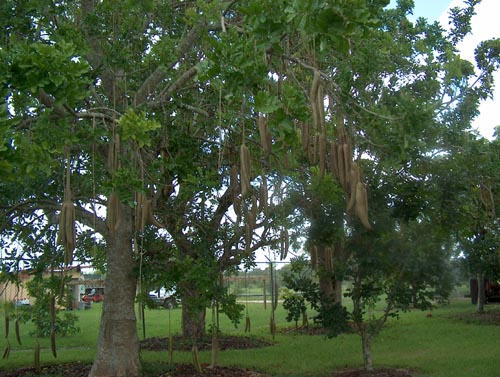
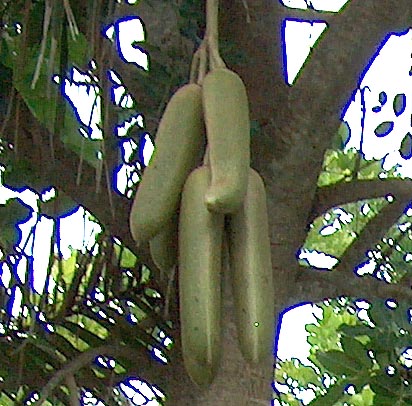
Fruit for Thought: Kigelia (Sausage Tree Fruit)

A member of the Bigona family, the South African sausage treeSausage Tree - CLICK FOR LARGER IMAGE (Kigelia pinnata orK.africana), has hundreds of huge sausage-like fruits that hang down from the limbs on long, rope-like stalks. The fruits may be over 2 feet long and weigh 20 pounds, and have inspired a wide variety of vernacular names, including one, in South Africa, that means ‘the fat tail of a sheep’.

Sausage Tree - CLICK FOR LARGER IMAGEThe hard, grey fruit of the sausage tree has a thin skin covering a firm, fibrous fruit pulp containing numerous small seeds. The fruit, although inedible itself, is a common ingredient in traditional beer, and is said to hasten the fermentation process. Kigelia leaves are an important livestock fodder, and the fruits are much prized by monkeys and elephants.

The fruit is also used as a cosmetic cream. The Tonga women of the Zambezi valley, for example, regularly apply preparations of the Sausage fruit to their faces, to ensure a blemish-free complexion.


(Some information is from the Southern African Natural Products Trade Association)
Photos by Chef James, taken at Fruit & Spice Park, Homestead, FL

Wednesday, October 12, 2011

Fruit for Thought: Feijoa

The feijoa, also known as the pineapple guava and the guavasteen, is an exotic and interesting fruit that is native to South America (Argentina, Brazil, Paraguay, and Uruguay) and is also grown in New Zealand and in the United States, in California and Florida. It is a sweet fruit whose taste is similar to a combination of the following fruits: banana, strawberry, guava, and pineapple.

Feijoa fruits are grown in subtropical regions where the climate is mild, and are produced from the feijoa tree, which is a small evergreen that can grow up to 12 feet in height. The tree is fairly hardy and resistant to many diseases and pests. Additionally, the feijoa tree produces small, inch-long flowers that are white in color with some sprinkling of purple in them. These flowers bloom in the spring. Additionally, petals from the feijoa flower are edible. They are somewhat sweet in taste and are typically used as an addition to salads. Regarding feijoa fruits, the fruits appear on a feijoa tree once the tree has aged approximately three years from initial seeding.

You can recognize a feijoa fruit by its blue/green skin that varies in texture from smooth to coarse. Additionally, feijoas are oval in shape and are approximately one inch to 3 1/2 inches in length. Although you should not eat the skin of a feijoa fruit raw, you can use it as an ingredient in preserves. When you cut into a feijoa, you will see thick, juicy flesh that is either light yellow or white in color. Additionally, approximately thirty seeds are present within the flesh. These seeds are very small and can be eaten along with the flesh. The feijoa fruit is also known for its fragrant and long-lasting aroma.

Tuesday, October 11, 2011

Fruit for Thought: BreadFruit


Breadfruit is a staple fruit across much of the South Pacific, spread by Polynesian people across the Southern Seas during their long sojourns. It can be found in Hawaii, Micronesia, and a variety of other places in between, as long as the weather is warm, because breadfruit cannot tolerate cool climates. Breadfruit is also cultivated in the Caribbean, where it is eaten in a variety of dishes. Breadfruit is a member of the mulberry family and resembles mulberry fruits somewhat, although breadfruit is much larger.
The breadfruit tree is a majestic, dark leaved specimen that can reach heights of 85 feet (26 meters). The fruits appear at the tips of the branches in groups of three or less, starting out green and ripening to rich brown or lavender in some varieties. With over 200 known varieties of breadfruit, there are a wide range of sizes, flavors, and colors to choose from. The surface ofbreadfruit is rough and covered with small four- to six-sided polygonal shapes that sometimes terminate in pliable spines. In shape, the breadfruit is roughly oblong, depending upon the variety.

There are both seedless and seeded breadfruit cultivars. The seeded varieties can be grown from seed, although the seeds must be used quickly, because they soon lose the ability to germinate. The seedless variety is cultivated by propagating sucker plants from the roots, which is accomplished by exposing the roots and injuring them. Both varieties produce a high volume of natural latex, which is used as a ripeness indicator.
Breadfruit can be eaten green or ripe. In the green stage, it is treated as a vegetable and requires cooking or processing to be eaten. In the ripe stage, breadfruit can be eaten raw.
Green stage breadfruit has a white, starchy interior and is firm to the touch. Ripe breadfruit has a creamy to yellow flesh, slightly pasty in texture, and is sweet to the taste. Many varieties ofbreadfruit produce year round, with fruits at various stages of ripeness on the tree at all times. In some cases, there are two or three peak seasons in which there is a higher proportion of ripe fruit.
Breadfruit has been cultivated for centuries by people in the South Pacific, and it came to the attention of Western explorers in the 18th century. Europeans were intrigued by the plant, which was clearly a staple of the Polynesian diet and served a vast majority of the nutritional needs of the Islanders. In the attempt to provide a cheap and steady source of food for the slave trade in the West Indies, breadfruit was carried over with some difficulties and cultivated there as well.
Breadfruit is rare on the American mainland, and many consumers don't know what to look for in the fruit or how to store it. If using ripened breadfruit, you should look for a slightly soft fruit with an even color and small globules of latex on the surface. Unripe varieties should be firm and evenly green. In both cases, the fruit should be used quickly. Breadfruit does not handle refrigeration well and should be kept in a thick bag to prevent cold damage.
Breadfruit is often boiled or roasted. When baked, it yields a texture and flavor surprisingly similar to conventional wheat bread. Unripe fruit can also be used to make a flour or paste, which can be used successfully in baking.
Breadfruit is often used to make poi, a fermented fruit product that is often made with taro as well. Breadfruit is also used to make puddings, candied to create snacks, and fried for chips. In addition, it provides animal fodder in some parts of the world.
Breadfruit is an unusual and underutilized fruit with many interesting properties. Depending on the region, it is prepared in a dizzying array of methods, many of which are quite tasty. While unlikely to take mainland American cuisine by storm in the near future, breadfruit is certainly worth trying on tropical adventures.

Wednesday, October 5, 2011

Fruit for Thought: Cherimoya


Cherimoya ( Annona cheirimola P. Mill. ) is an absolutely wonderful fruit which is becoming better known in the United States . It is now produced in limited amounts in Southern California . It is thought to be native to southern Ecuador and northern Peru , and is related to some fruits in the same genus which grow in more tropical areas. Cherimoya was probably taken to other parts of the world hundreds of years ago, so it is especially well known in Asia as well as throughout South and Central America . It is produced rustically in many parts of the world, but it is produced in commercial plantings only in semi-tropical areas of Spain , Chile , Peru , California , New Zealand , Australia , and Israel .
Some closely related species are produced in more tropical areas. Atemoya is an interspecies hybrid of cherimoya and sugar apple ( Annona squamosa ). The fruit has some qualities of cherimoya, and grows in hotter, more humid areas where cherimoya cannot be grown, in Florida , Hawaii , Australia , and Israel . Guanabana ( Annona muricata ) is grown throughout tropical South and Central America . It is larger than cherimoya, but has more fibrous flesh, and a very tart flavor. It is better suited to processing, especially into drinks, than to eating fresh. Paw paw ( Asimina triloba L.) is the only Annonaceae species native to North America, in valleys in the middle and eastern U.S.
Cherimoya is actually a compound fruit in which many fruitlets have fused into a single fruit. These fruitlets are called carpels. A carpel will develop with a seed and surrounding pulp if the ovary corresponding to that carpel is fertilized. The photo shows developed and undeveloped carpels. Carpels which are adjacent to carpels with seeds may also develop pulp. This suggests that seeds produce plant hormones which lead to pulp development, and that these hormones may diffuse to adjacent carpels.
The reason we love cherimoya so much is because of its pulp, which Mark Twain described as “deliciousness itself”. Cherimoya of different varieties have different flavors, and fruit “flavor” generally has three components, sweetness, acidity, and complexity. Generally the greater of each of these, the better the flavor. Sweetness is generally and conveniently measured by refractive index, with a portable and inexpensive device. Sweetness is expressed as “brix”, which is an index of total dissolved solids in the juice of fruit.

SweetnessBrix
Exceptionally sweet25 - 30
Very sweet19 - 24
Acceptable15 - 18
Poor12 - 15
Acidity is measured as titratable acid, which means how much base, or alkaline material, must be added to neutralize the acid in the juice. Greater acidity produces a greater “tartness” to the taste, and is complementary to sweetness. Both qualities are necessary for most palates to consider it a good taste.
Complexity is more difficult to measure. It consists of the content of a variety of different fruit compounds. It makes a fruit have a tinge of almond, or a tinge of orange, or whatever. It adds a variety of flavors to simple sweetness, and is also necessary for good taste.
The seeds are large, black, and inedible. Although some efforts have been made to develop cherimoya without seeds, or with fewer seeds, the best solution to this has remained producing very large fruit, which have more pulp in relation to the seeds. So far seeds seem to be necessary to development of fruit pulp.

Thursday, September 29, 2011

Fruit for Thought: Ackee


Ackee is the national fruit of Jamaica and is one of the main ingredients in the popular breakfast dish "Ackee and Saltfish." Ackee is not indigenous to Jamaica but was imported from West Africa during the 18th century, the name is derived from the West African name "Akye Fufo". Whilst the tree is grown in many countries, it is only known to be cultivated for food in Jamaica

Each fruit consists of three black seeds surrounded by yellow flesh and a skin which turns red on maturity of the fruit. Upon ripening, the red skin opens up revealing the flesh and seeds.

It is important that ackees are not picked until the skin has opened up as the flesh contains toxins up until this point. Knowledge of proper harvesting techniques is widespread in Jamaica so cases of poisoning are rare. In any case, serious illness due to eating unripe ackees has only been recorded in those who are already ill or frail. However, if you experience nausea and vomiting around two hours after eating ackee then seek medical treatment!


Ackee and Saltfish recipe

Ingredients

You will need the following ingredients to prepare enough ackee and saltfish for 4 people:-
Ackee and Saltfish - Ingredients 1/2 lb Saltfish (dried, salted codfish)
 12 fresh ackees or 1 (drained) can of tinned ackees
 1 medium onion
 1/2 tsp black pepper
 3 tbsp of butter
 1/2 a hot chilli pepper (ideally Scotch Bonnet)
 1 sweet pepper
 1 chopped tomato
 1 sprig fresh thyme or 1 tsp dried thyme


Optional ingredients:-
2 cloves of garlic
4 Scallion (or spring onions)
6 Slices of bacon

Preparation: Take a look at video. Enjoy!!!


Wednesday, September 28, 2011

Fruit for Thought: Rambutan

 The Rambutan is a tropical tree which belongs to the Sapindaceae family and also the fruit of this tree. Although it does not grow very tall, it produces an ample harvest. Rambutan is widely distributed throughout Indonesia, Malaysia and Southeast Asia and is identified in some countries, by different names. For example, in Nicargua, Costa Rica and Panama, Rambutan is identified as mamon chino while Thailand people call it ngoh. In Malaysia, another type of Rambutan is sold called wild Rambutan. Although the common color of Rambutan is red, the fruit of this particular type is yellowish. The hairy skin of the Rambutan fruit is removed to get to the whitish or pinky edible parts. They typically taste sweet though some are sour as well as sweet. 

Rambutan is a tasty fruit and it is very popular in many countries. Seed oil from the Rambutan is produced and in use to manufacture candles and soap. Although Rambutan trees are cut down rarely, their wood is used in the construction industry. Rambutan fruit is said to heal dysentery and diarrhea effectively. The leaves are also used as cataplasm to cure headaches. In Malaysia, the skin of the Rambutan fruit is used to prepare native medicines. Further, the roots of Rambutan trees are boiled and used as a medication to cure fever.

Rambutan fruit is rich in following components: Fat, Calcium, Iron, Protein, Nitrogen, Ash, Sodium, Zinc, Magnesium, Manganese, Potassium, Phosphorus, pH, Vitamin C, Vitamin A, Thiamin, Riboflavin, Fiber. Eating five fruit in a day can seriously decrease the chance of cancer. Rambutan fruit is also very effective in lowering blood pressure.

Open Rambutan fruit by removing one part of its skin. Find the seam across the fruit and pull apart the leathery skin. You can also use the knife, but be careful, only cut through the skin. Then you can hold the fruit with your fingers and enjoy the sweet taste.
Rambutan fruit cannot be cooked; it can be eaten raw only.

Wednesday, September 21, 2011

Fruit for Thought: Mangosteen

Mangosteen

The mangosteen fruit is a small, purple fruit about the size of a tangerine, with a rind similar in texture to the pomegranate. In Thailand, it is known as the “queen of fruits” and is prized the world over for its taste and medicinal value.

In India, Thailand and China, preparations made from the rind are used as antimicrobial and anti-parasitic treatments for dysentery and other forms of infectious diarrhea. The plant’s astringent qualities are also useful in preventing dehydration and the loss of essential nutrients from the gastrointestinal tract of diarrhea sufferers. The Thai people take advantage of the mangosteen’s antimicrobial properties to treat infected wounds, tuberculosis, malaria, urinary tract infections, syphilis, and gonorrhea.
It has long been recognized in Asia that the mangosteen has powerful anti-inflammatory properties, and is therefore effective in treating eczema, hyperkeratosis and related skin conditions such as psoriasis and seborrhea. In the Caribbean, a tea made from mangosteen, known as “eau de Creole,” is used as a tonic for fatigue and low energy states, universal symptoms experienced by millions around the world. Brazilians use a similar tea as a de-worming agent and digestive aid. In Venezuela, parasitic skin infections are treated with poultices of the fruit rind, while Filipinos employ a fruit preparation to control fever. While known in many parts of the world for centuries, the mangosteen fruit is only now being discovered by North Americans. This is unusual considering that North America is often the first area to benefit from medical discoveries; in this case, however, it is one of the last. Fortunately, knowledge of the mangosteen is spreading quickly, and it is becoming known in countries far removed from where it is grown.
  Mangosteen Yogurt Panna Cotta
Mangosteen and Lime Sorbet


Mangosteen Mousse


For these great recipes involving Mangosteen, please click below. try one out and let us know if it's a winner. Enjoy!!!

Friday, September 16, 2011

Daily Bread


Verse of the Day

“And we have known and believed the love that God hath to us. God is love; and he that dwelleth in love dwelleth in God, and God in him.”


Wednesday, September 14, 2011

Fruit for Thought: Dragon Fruit


Pitaya Fruit, Pitahaya Fruit or commonly known as the Dragon fruit is among the most nutritious and wonderful exotic fruits. It is a favorite to many, particularly people of Asian origin. It features a mouth watering light sweet taste, an intense shape and color, not forgetting its outstanding flowers. In addition to being tasty and refreshing, this beautiful fruit boasts of a lot of water and other vital minerals with varied nutritional ingredients.
Due to its vital nutrients, the Pitaya fruit is suitable for all diets as it supplements fiber which is best for laxative and the liver. Similarly, people who have high blood pressure, diabetes and obesity have attested to the fruit’s goodness. Recent findings show that if an obese person eats a Pitahaya fruit on a regular basis, it naturally reduces the weight considerably, creating a well balanced body without compromising on the individual’s health.

Dragon Fruit CremeThis is a little treat that I concocted that you might like for a simple dessert or with an afternoon cup of tea.
1/4 c fresh coconut water
meat of one fresh coconut
meat of one dragon fruit (1 slice for garnish reserved)
1/2 tsp vanilla
1 tsp agave syrup & 3 drops stevia or both as you may
1/3 cup cashews- soaked 30 mins and drained

Method: Blend well in high speed blender, garnish with a piece of dragon fruit with the pretty skin on and serve. This tends to thicken a bit if it stands for a while but is best served same day to benefit from all the fresh nutrients.
I hope you will give the pretty dragon fruit a try if you haven’t already.  You’ll be glad you did.  
Text & photo by The Alkaline Sisters

Thursday, September 8, 2011

Fruit for Thought: Kiwano (Horned Melon)

Image:Kiwano_138.png
The horned melon (Cucumis metuliferus), also called African horned cucumber or melonjelly melonhedged gourdEnglish tomatomelano, or kiwano and also known as "cherie", is an annual vine in the cucumber and melon family. It is considered to be the ancestor of the other cultivated melons. Often known by its nickname in the southeastern United States - blowfish fruit - it is grown for its fruit, which looks like an oval melon with horn-like spines. The fruit of this plant is edible, but it is used as often for decoration as for food. When ripe, it has a yellow-orange skin and a lime green jelly-like flesh with a tart taste, and texture similar to a cucumber. The horned melon is native to Africa, and it is now grown in CaliforniaChileAustraliaand New Zealand as well.


In Zimbabwe, this cucumber is called 'gaka' or 'gakachika' and it is primarily used as a fruit-snack, salad, and, rarely, for decoration. It is eaten young, mature green, or when ripe - bright yellow/orange (i.e., at any stage of its development). It grows naturally in the fields and also in the bush. However, some people leave some to rot in the fields for next summer seeds/plants. Its taste has been compared to a combination of cucumber and zucchini[1] or a combination of banana, cucumber and lemon.[2] Some eat the peel as well. It has a replica that does not have horns, but looks and tastes similar. The seeds are covered in a gelatin-like substance. The skin is very rich in vitamin c and fiber. A small amount of salt or sugar can increase the flavor. The fruit can be used in cooking, but when eaten raw, most suck out the pulp and spit out the seeds, although eating the skin and/or the seeds is also known.

Wednesday, September 7, 2011

Fruit For Thought: Akebi

Akebi is a mysterious and beautiful fruit native to the north of Japan and has only been cultivated and available in stores only in recent decades. The translucent white flesh inside, filled with countless white capped shiny black seeds is eaten as fruit. Unbeknownst to many, the purple pod can be cooked and eaten as well, but like a vegetable, not a fruit! Now that is a versatile fruit!
About the Mysterious Akebi Fruit アケビ 木通
Traditionally, the image that many Japanese have of akebi is a wild fruit that scruffy country kids pluck and eat from vines in Tohoku (North Honshu) while playing in the mountains. As people became ever more interested in discovering new and interesting culinary sensations, a variety of akebi that could be cultivated was developed. Cultivation only began about 20 years ago and is centered mainly in Yamagata Prefecture in the Tokohu region of Japan.
After enjoying akebi as a fruit, you can try it as a vegetable. Again, the inner flesh of the akebi is eaten as fruit and the outer pod is prepared and eaten like a vegetable, mostly in the Tohoku (North Honshu) region of Japan.
There are a number of ways that the pod may be cooked and eaten including grilled, sauteed and tempura. The pod is pleasantly bitter and cooking takes the bite off the bitterness. We sauteed ours in miso which is a perfect contrast to the bitterness of the pod. (This is not Kyoto cuisine.)
Washed and Sliced Akebi Pod
Miso Sauteed Akebi (Miso Itame) あけび みそ炒め
Miso itame is a common way to saute vegetables in Japan. First the vegetable is sauteed with oil then a mixture of ryorishu (cooking sake), shoyu, mirin, sugar and miso is added and sauteed for a few more minutes. Miso itame is a very tasty, quick and versatile dish that combines the taste of sweet, pungent (miso) and salty.

Recipe for Akebi Miso Itame あけび みそ炒め
Ingredients
  • 1 akebi pod (inner fruit removed)
  • 2 tablespoons oil (sesame oil is nice)
  • 1-2 teaspoon miso paste (same as for miso soup)
  • 1 teaspoon sugar
  • 1 teaspoon shoyu (Japanese soy sauce)
  • 2 tablespoons of ryorishu (cooking sake or sake)
  • shiso leaf (fresh green shiso leaf) optional
I used at least 2 teaspoons of Kansai-style sweet miso paste which is light in color. Tohoku style miso is red and saltier and you might want to go easy on the amount if you are using that style of miso. Adjust amount based on the kind of miso you are using and of course your taste.
Preparation
If you would like to remove some of the bitterness you can soak the pod halves or slices in warm water for 30 to 60 minutes. Pat dry before sauteing.
Mix all the liquid ingredients together in a bowl, dissolving the miso paste and sugar.
Heat a fry pan and add several tablespoons of oil. Once hot, add sliced akebi pod and saute covered until akebi softens, this should take about 2 minutes.
Pour in liquid ingredients, reduce heat and simmer down until little liquid remains. This should take 1 to 2 minutes. Due to the high sugar content, the mixture will quickly burn – don’t allow that to happen. Once the liquid has been reduced, serve on a plate and garnish with chopped shiso leaf.
Information and Photos Taken from the following website: http://kyotofoodie.com/japanese-fruit-akebi-sauteed-vegetable/